Evolt 360 for clinics: what the scanner is, where BIA breaks, and when to switch

Heading 2
Heading 1
Heading 3
Heading 4
Heading 5
Heading 6
Lorem ipsum dolor sit amet, consectetur adipiscing elit, sed do eiusmod tempor incididunt ut labore et dolore magna aliqua. Ut enim ad minim veniam, quis nostrud exercitation ullamco laboris nisi ut aliquip ex ea commodo consequat. Duis aute irure dolor in reprehenderit in voluptate velit esse cillum dolore eu fugiat nulla pariatur.
Block quote
Ordered list
- Item 1
- Item 2
- Item 3
Unordered list
- zz
- Item B
- Item C
Bold text
Emphasis
Superscript
Subscript
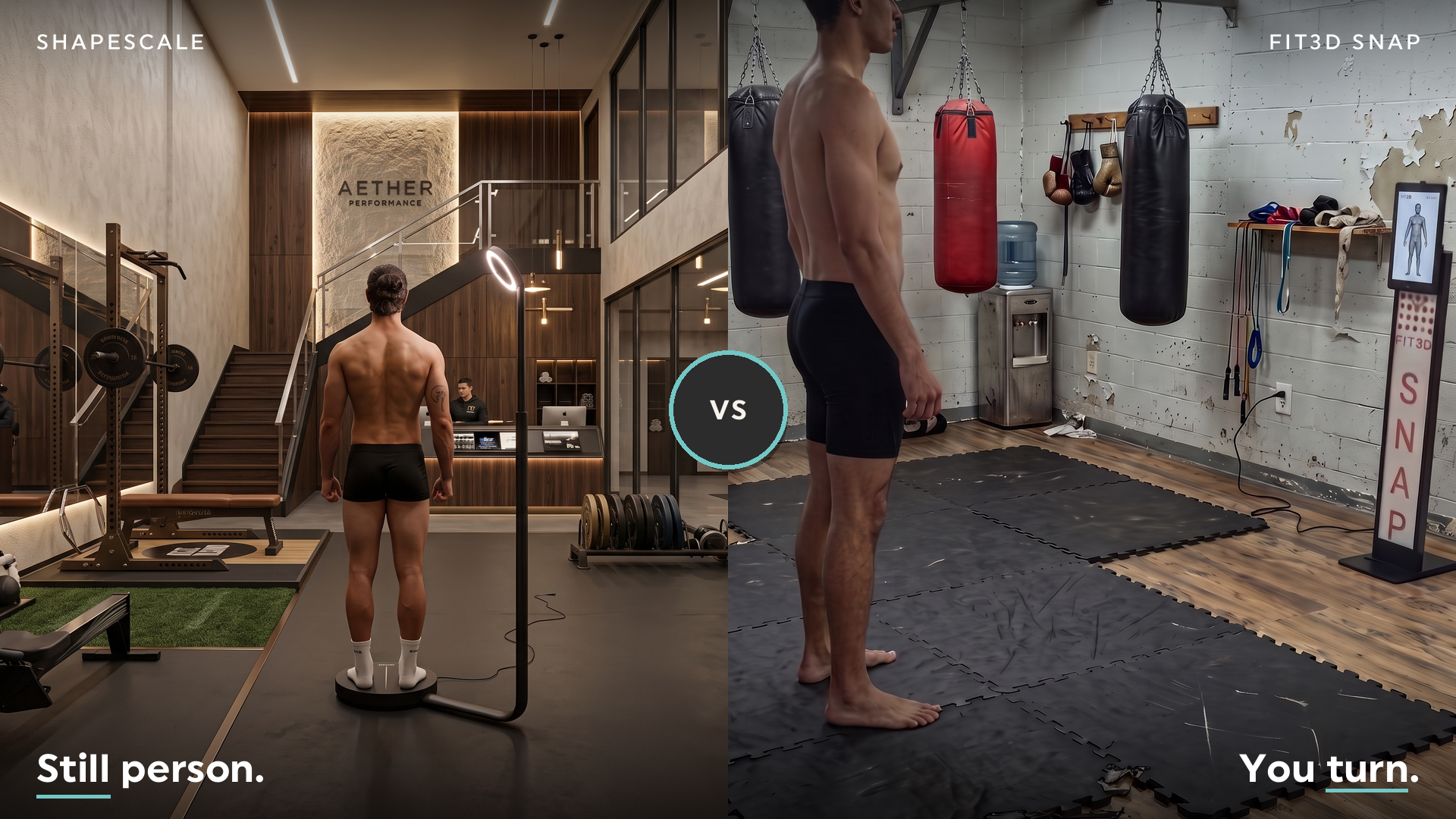
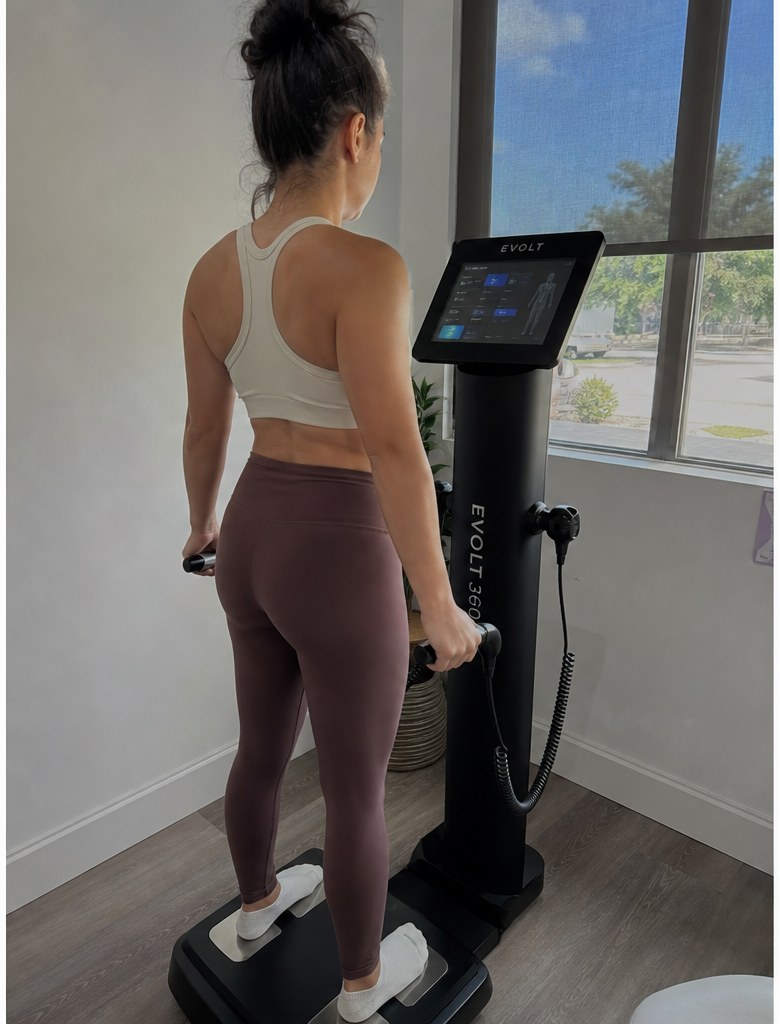
You are comparing Evolt 360 and ShapeScale for a clinic or a fitness business. Evolt is a commercial bioelectrical impedance analysis (BIA) column. Hand and foot electrodes, about 60 seconds, 40+ metrics, a Bio Wellness Index (BWI), and the Evolt Active app. Gyms already have them on the floor. ShapeScale is optical 3D. The person stands still, the sensor moves, and composition is predicted from the full mesh by a deep-learning model trained on paired scans vs GE Lunar iDXA. This page is for a gym or studio, med spa, plastics practice, wellness clinic, or GLP-1 program. Not the member who wants to know how to stand on the plate.
Who should buy which
- Keep an Evolt 360 if you already run a high-volume gym floor. You want a ~60-second add-on, and you will only use the number as a trend under a locked protocol (time of day, fasting, no workout).
- Buy ShapeScale if the consult or trainer walkthrough has to show a photoreal body plus girths, volumes, composition trained on iDXA, and a PDF they can take, on iPhone or iPad, in the room.
- Do not treat Evolt's average 98-99% repeatability, rivaling that of a DEXA scan, as agreement with dual-energy X-ray absorptiometry (DXA). Repeatability is same person, same protocol, similar number. A scale that is consistently 4 points low is highly repeatable and still wrong for a consult. We did not put an Evolt 360 in the March 2026 white paper. We did not find a peer-reviewed Evolt 360 vs DXA paper with a named n / mean absolute error (MAE).
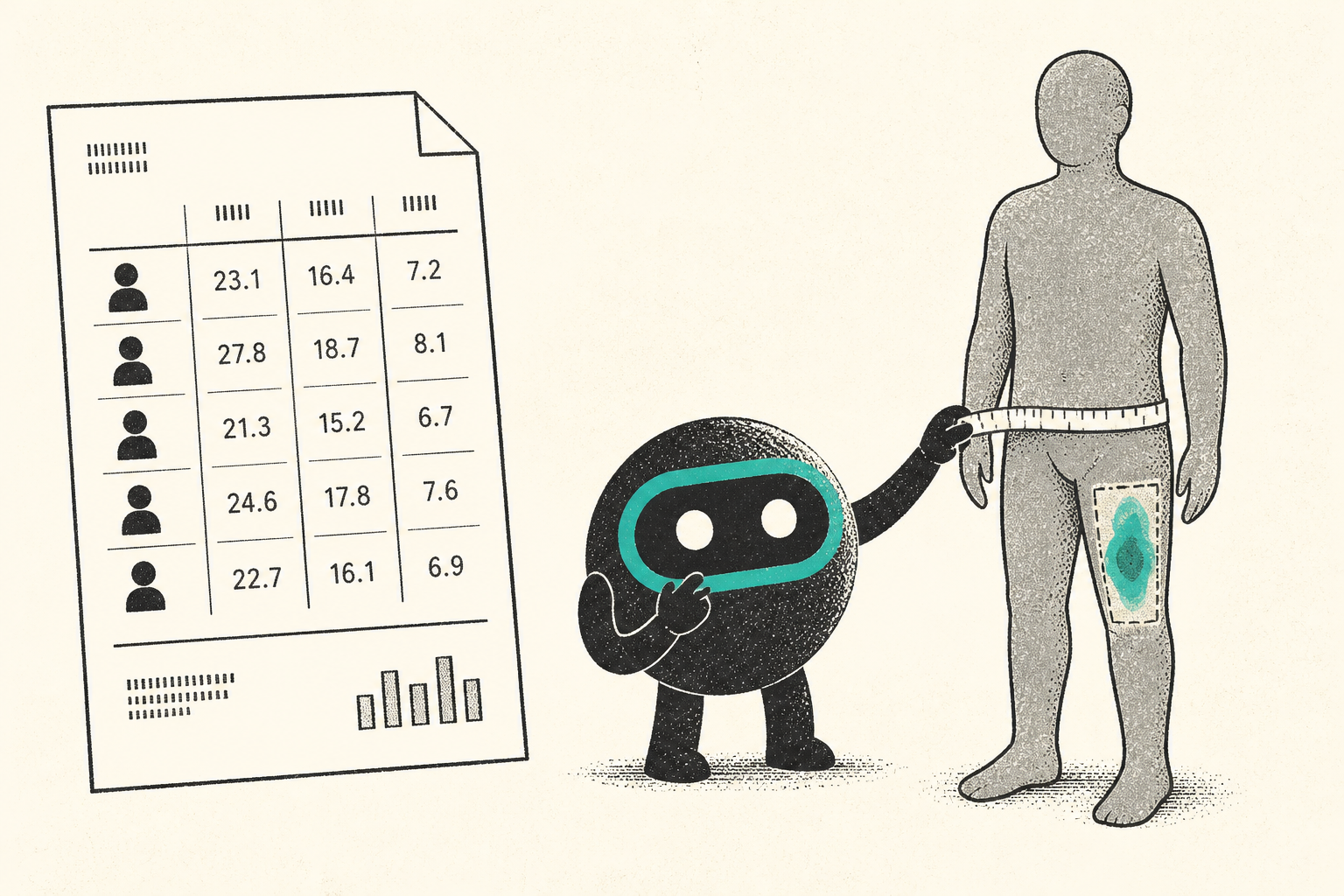
Evolt vs ShapeScale
| Question | Evolt 360 (commercial BIA) | ShapeScale |
|---|---|---|
| Is it a 3D scanner? | No. 8-electrode BIA. Resistance estimate, not a mesh. | Yes. Optical 3D. Sensor head moves around a still person. |
| Person stands still? | Yes, on electrodes, holding the handles. Current through the body. ~60 seconds. | Yes, on a 2-ft base. The sensor moves. 5 ft rotation clearance; 6x6 ft recommended; 7 ft ceiling. |
| Electrodes / current? | Yes. Evolt KB: BIA requires strict standardization. Sale terms: no guaranteed consistency when prep is off; not to diagnose, treat, cure, or prevent disease. | No current. White-paper limitations are clothing, hair, and stance. |
| Composition method | Estimates fat, lean, segmental muscle, visceral fat, and water from resistance. Packages output as BWI instead of body-mass index (BMI). Not DXA. | Deep-learning composition from the full 3D mesh, trained vs GE Lunar iDXA (current model; March 2026 white paper). |
| Named MAE vs DXA? | No. Vendor language is 98-99% repeatability. Independent figures here are BIA-class (InBody 770 papers), not an Evolt MAE. Dial H20 in the same white paper: MAE 5.01 pp, R2 0.44 (consumer BIA, not Evolt). | Body-fat MAE 1.89 pp, R2 0.91 |
| Lean / appendicular lean mass (ALM) | BIA estimate. No Evolt-vs-iDXA paper found. | Lean MAE 3.3 lb / 1.49 kg (average lean-mass error vs DXA, per ShapeScale's March 2026 white paper), R2 0.98; ALM MAE 2.1 lb / 0.97 kg, R2 0.96 |
| Photoreal 3D + heatmaps? | No. Numbers, BWI, paper / app charts. | Yes. Photoreal 3D, girths, volumes, heatmaps on iPhone or iPad. PDF of one scan or a two-scan compare. |
| iOS consult vs printout | Printout + Evolt Active. App Store 1.9 / 5 from 94 (16 Aug 2026). Play 2.7 / 5 from 684. Listing: fitness / general information only; no warrant that app info is complete or current. Offline scanners do not upload. | 4.0 / 5 App Store (43), iOS. 3D on iPhone or iPad. Android is not available. |
| Posture score? | No. | No. Keep Fit3D if posture is the product you sell. See Fit3D. |
| Return-scan staff work? | Staff typically run the column; result lives on a sheet if the app does not sync. | First scan: QR from the app. After that, face and body recognition. Rainbow lights. No app. No buttons. Works across even hundreds of users. |
| AI guidance on goals? | Not claimed here. | Shipped in the app. Saves consult time. |
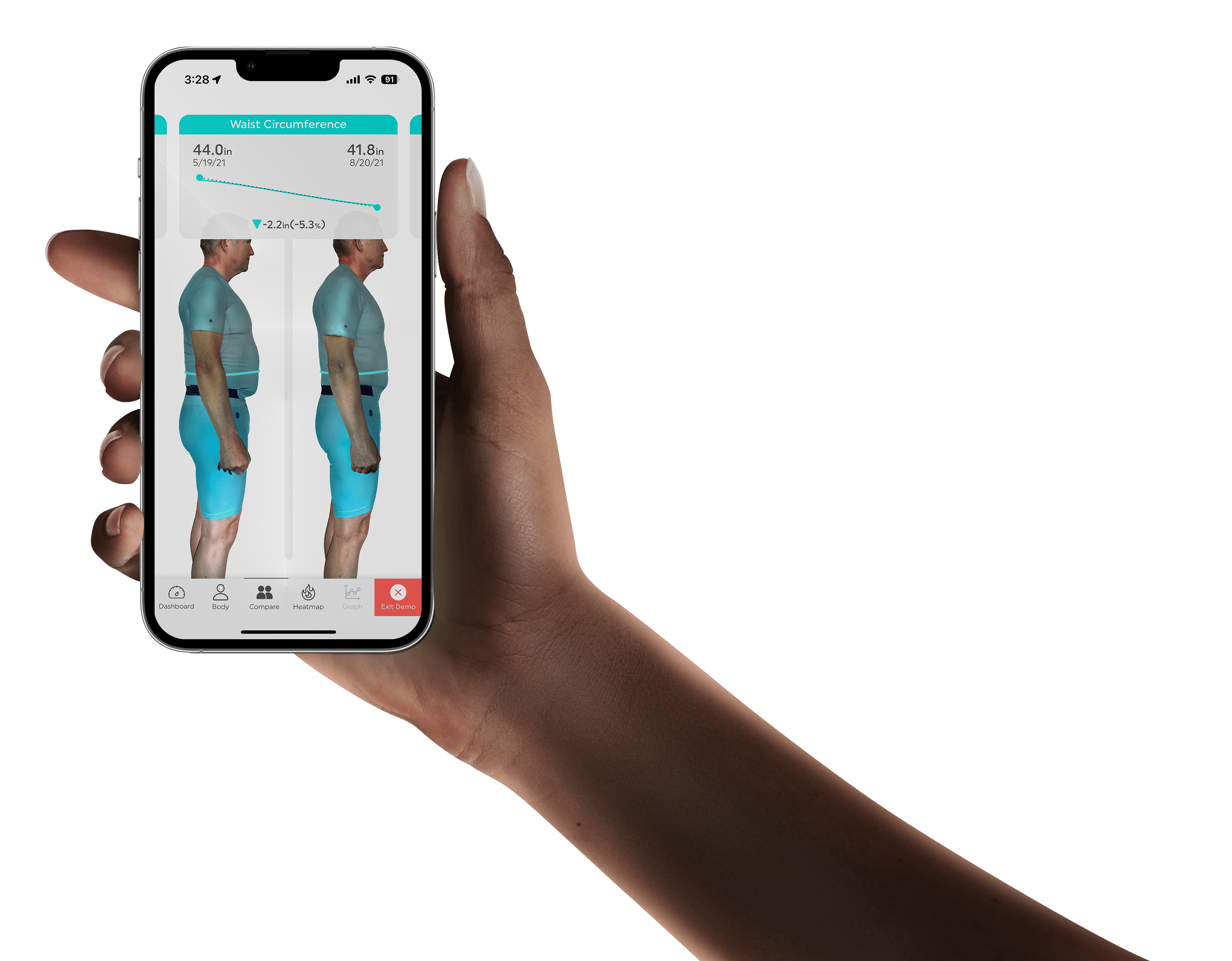
Girths ShapeScale lists today: neck, shoulders, chest, biceps, waist, hips, thighs, calves. Volumes: arms (one combined arm volume in Compare / Body / Heatmaps / PDF), torso, legs. Also: fat mass, LMI, ALM, visceral fat as a mass, Health Score, Shape Score. Height is typed in.
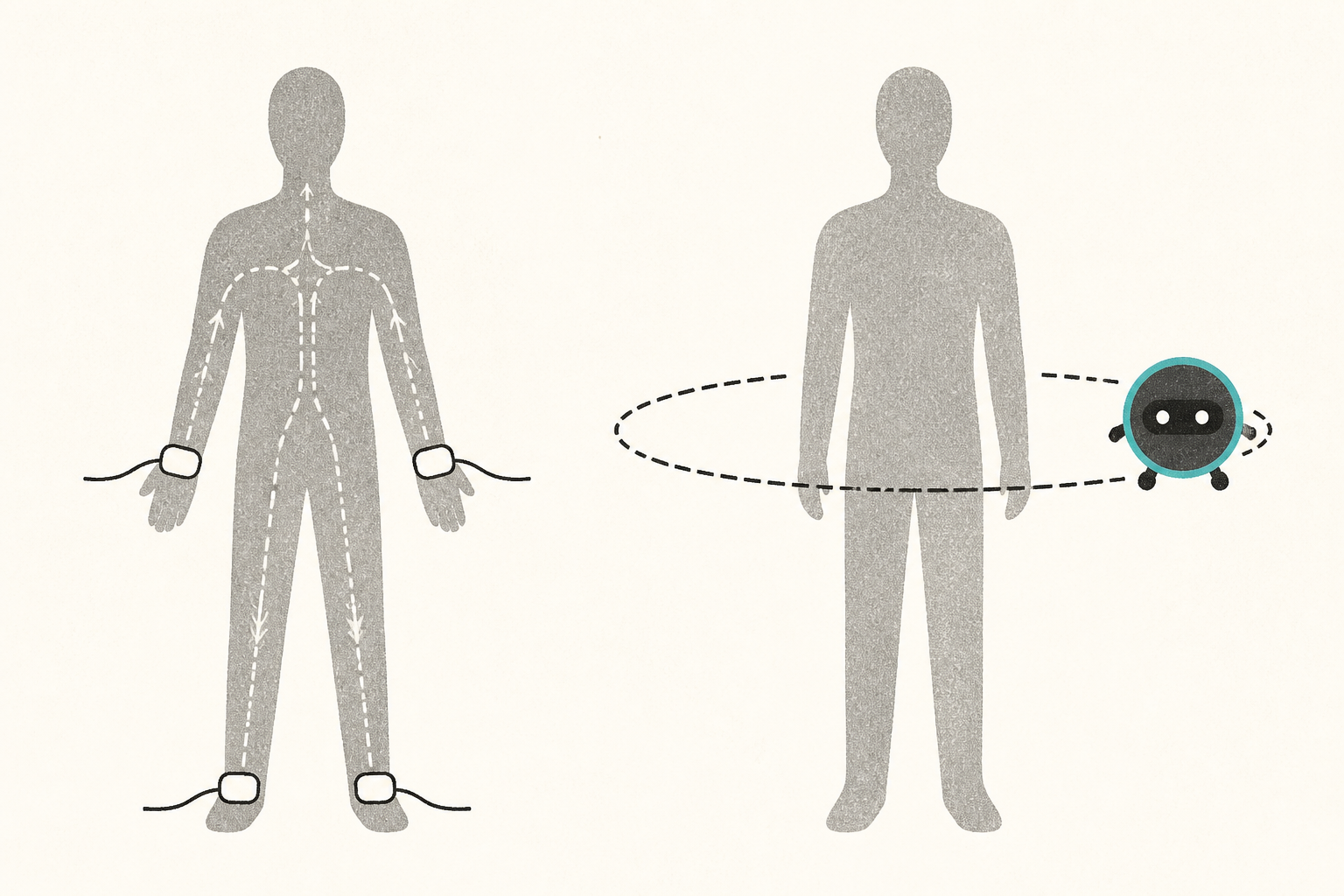
What Evolt 360 actually is
Evolt 360 sends a low-level current through the body via hand and foot electrodes. Muscle (high water) conducts. Fat does not. The device estimates fat, lean, segmental muscle, visceral fat, and water from that resistance, then packages the output as a Bio Wellness Index instead of BMI.
Evolt sits in the same measurement class as InBody. The output is a resistance estimate, not a DXA scan and not a 3D mesh.
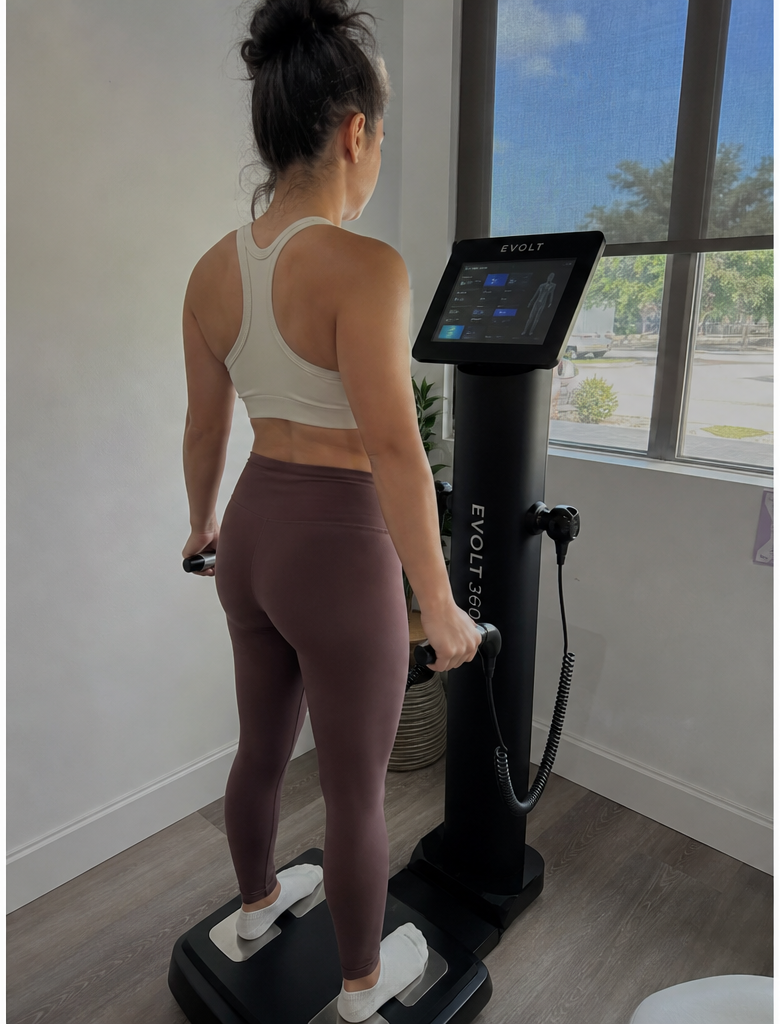
Evolt's own knowledge base is clear that BIA requires strict standardization of testing conditions and that training load, food, supplements, and medications move the number. Their sales terms say they cannot guarantee scanning consistency when prep is off, and that the product is not intended to diagnose, treat, cure, or prevent any disease.
The 98-99% claim is repeatability, not accuracy
Evolt's accuracy page says the device has an average 98-99% repeatability, rivaling that of a DEXA scan.
Repeatability means the same person, same protocol, same day, similar number. It is not agreement with DXA. A scale that is consistently 4 points low is highly repeatable and still wrong for a consult.
We did not put an Evolt 360 in the March 2026 white paper. We also did not find a peer-reviewed Evolt 360 vs DXA paper with a named n / MAE. Do not treat any number below as an Evolt MAE. Those figures are BIA-class performance.
That white paper (optical 3D vs GE Lunar iDXA, n=1,000+ adults, no participant overlap across train / validation / test):
- ShapeScale (optical 3D, current composition model): body fat MAE 1.89 pp, R2 0.91
- InBody Dial H20 (consumer BIA, same study): MAE 5.01 pp, R2 0.44 (not Evolt)
Lean mass: 3.3 lb (1.49 kg) average lean-mass error (MAE) vs DXA, per ShapeScale's March 2026 white paper, R2 0.98. ALM: MAE 2.1 lb (0.97 kg), R2 0.96.
Independent work on professional multi-frequency BIA (InBody 770, not Evolt) vs DXA still shows several-point error. Potter 2022: MAE 3.9 pp and a -3.4 point fat under-read in fit Marines. Lahav 2021: -3.1 pp mean under-read in a clinical sample, limits of agreement from +2.6 to -8.9. That is the BIA ceiling, not a device scandal.
A 4-week treatment change is often smaller than that error. If the scanner can move more than the treatment, staff stop using it as proof.
The app is part of the product, and it is a 1.9
US App Store, checked 16 Aug 2026: Evolt Active is 1.9 out of 5 from 94 ratings. Google Play, same day: 2.7 out of 5 from 684 reviews. The App Store listing says the app is for fitness or general information only, is not designed for medical purposes, and that Evolt does not warrant that any information available on the App is complete, accurate, true or current.
The recurring 1-star theme is scans that never sync. Evolt's own help page says offline scanners do not upload. If the result lives on a printout and the app does not load, the patient does not come back to look at it, and you do not get the second consult.
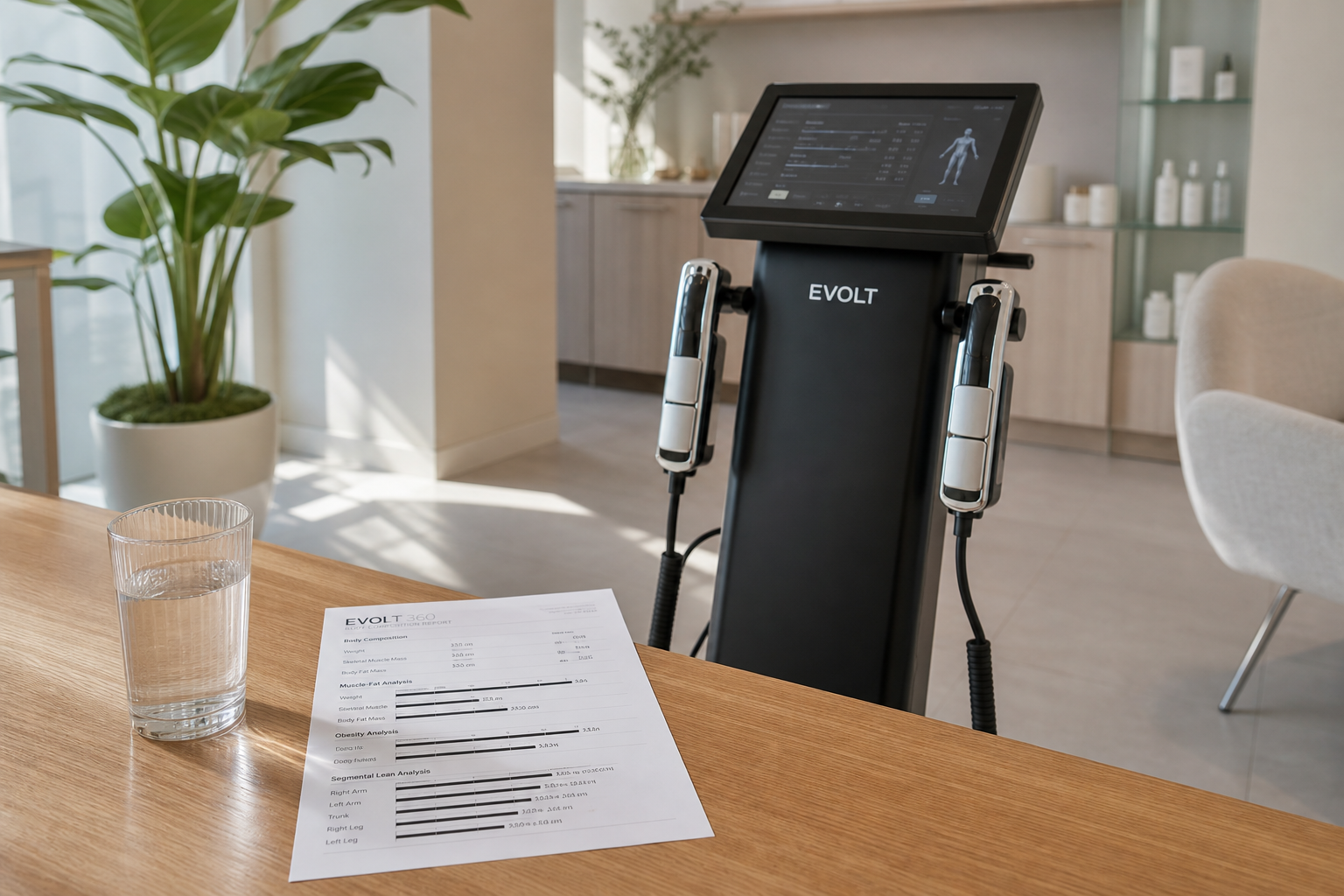
What that looks like in a consult
BIA is an estimate from electrical resistance. Resistance moves with hydration, recent food, caffeine, alcohol, exercise, and menstrual cycle. Two scans the same day can disagree. That is the method.
In a med spa or GLP-1 clinic it shows up as:
- A patient who gained fat because they were dry
- A number that fights the photo
- Staff who stop trusting the device
- No visual a patient will share or pay to see again
Evolt can still track a trend if you lock time of day, fasting, and no workout. It is a weak proof tool for aesthetics and medical weight loss.
Contouring, tightening, red light, and plastics
Evolt is the same measurement class as InBody. Current through electrodes. A resistance estimate. No mesh. CoolSculpting, RF tightening, red light, Emsculpt-class work, and lipo or fat grafting change a zone. BIA cannot show the zone. Composition % can sit still, or swing with a 4-11 lb (2-5 kg) TBW (total body water) move Evolt itself documents, while waist, hip, thigh, or abdomen shape changes. That is the method, not a bad operator.
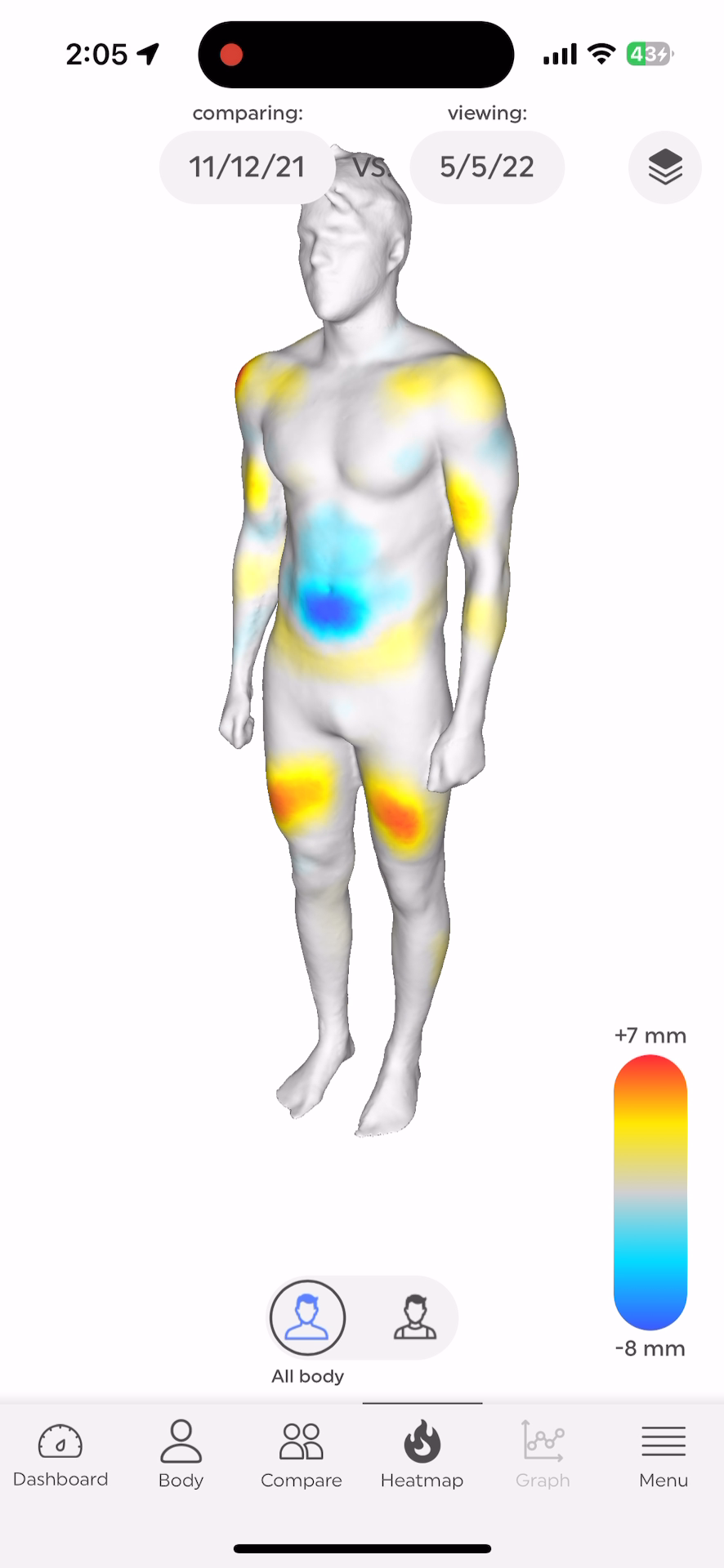
ShapeScale is the proof layer for those consults. Mesh girths: neck, shoulders, chest, biceps, waist, hips, thighs, calves. Regional volumes: arms combined, torso, legs. A volume heatmap (blue down, yellow/red up) lets you point at the treated area. It does not measure skin quality, collagen, redness, or treatment energy. Keep photos for texture. Keep Evolt if you only need a locked-protocol trend on a gym floor.
Dr. Johnny Franco (Austin Plastic Surgeon):
ShapeScale has truly revolutionized how we guide patients through their weight loss journey. It makes it so much easier for them to visualize their transformation and track progress, because it is no longer just about losing weight.
Trina Barr (Innovaes Med Aesthetics):
ShapeScale provides visible, tangible, absolutely undeniable metric of proof that was missing from our practice.
What gyms and trainers actually say
Evolt's own knowledge base is written for the operator who has to defend the number. The title of the page is Why Are My Clients' Scan Results Wrong? Their first line:
One of the most common concerns raised by trainers and scan users is that results appear inconsistent or inaccurate from scan to scan.
Their answer is total body water (TBW). A 4-11 lb (2-5 kg) TBW swing, they say, will move skeletal muscle, fat mass, and body fat % even when the client did not gain fat or lose muscle. That is Evolt telling staff the consult fight is normal.
Mildly positive, from an Anytime Fitness franchisee on Evolt's own site (Ben Chalmers): Evolt has been a game changer for our club. Jack at Vision Personal Training, also an Evolt case study: It gives me objective data to talk about rather than just my opinion. It is right there on paper for the client to see.
Jack's on-paper line is the gym-floor pitch. A clinic consult needs more than a sheet.
The app is what the member takes home. One gym member (App Store):
The misery of trying to use the app undermines any value of the scanner. I'm paying to use this machine at my gym but will stop because I have no access to the data, not even from a website.
Another, on the number itself (App Store):
I took a scan and received incorrect lean and fat percentages. My body fat is almost 40%, and yet the scans insists I am below 18%. A 20% difference is not acceptable. Given the cost of these machine, in the thousands of dollars each, you would think good customer support would be included.
Google Play (2.7 / 5, 684 reviews):
Scans frequently don't show on app. If you are being charged to use this scale, I would 100% ask for money back. I don't want to carry around a sheet of paper with my results and manually draw charts.
Styku is a different comparison (rotating-platform 3D). That write-up stays as-is: ShapeScale vs Styku.
When Evolt is enough
Keep it if you run a high-volume gym floor, you want a 60-second add-on, and you will only use the number as a trend under a locked protocol.
Do not buy another BIA column if the job is to show a plastics, GLP-1, or body-contouring patient that the treatment worked.
Thurston Pym (Resistanz Studio): ShapeScale is like having a DEXA scan in your studio, but faster, less intimidating, and far more engaging.
Source: Resistanz Studio case study
FAQ
Is Evolt 360 a 3D scanner?
No. Evolt 360 is BIA. Same class as InBody. ShapeScale is optical 3D. Fit3D and Styku are turntable optical. Do not treat an Evolt column as a Fit3D avatar.
Is Evolt a DXA scan?
No, and neither is ShapeScale. Evolt estimates composition from resistance. ShapeScale predicts composition from the full 3D mesh with a model trained on paired scans vs GE Lunar iDXA.
Is the 98-99% claim accuracy vs DXA?
No. Evolt's accuracy page says an average 98-99% repeatability, rivaling that of a DEXA scan. Repeatability is not agreement with DXA.
Did you validate an Evolt 360 in the white paper?
No. The March 2026 white paper compared ShapeScale's current composition model and an InBody Dial H20 (consumer BIA) to GE Lunar iDXA. Dial H20: MAE 5.01 pp, R2 0.44. That is not an Evolt MAE. We did not find a peer-reviewed Evolt 360 vs DXA paper with a named n / MAE.
Why quote InBody 770 papers on an Evolt page?
Because that is the published professional multi-frequency BIA ceiling, not a device scandal. Potter 2022: 770 vs iDXA, MAE 3.9 pp, bias -3.4. Lahav 2021: mean -3.1 pp, limits +2.6 to -8.9. Label every figure BIA-class / InBody 770, not Evolt.
What does Evolt say when the number looks wrong?
Their knowledge-base title is Why Are My Clients' Scan Results Wrong? First line: results appear inconsistent or inaccurate from scan to scan. Their answer is TBW: a 4-11 lb (2-5 kg) swing, they say, will move skeletal muscle, fat mass, and body fat % even when the client did not gain fat or lose muscle.
What do MAE and R2 mean?
MAE is the average size of a miss versus the reference. Lower is better. R2 says how tightly the estimate tracks the reference. Higher is better. Do not convert Evolt's 98-99% repeatability into an MAE.
What do ALM, LMI, BWI, and FFM mean?
ALM is lean tissue in the arms and legs. Fat-free mass (FFM) / whole-body lean is everything that is not fat and can move with water and gut contents. LMI is lean mass relative to height. BWI is Evolt's packaged index instead of BMI. ShapeScale reports ALM and LMI today. Evolt does not have a published ALM-vs-iDXA MAE we can cite.
Does ShapeScale do posture analysis?
No. Neither does Evolt. Fit3D reports tilt, shift, and ProScanner balance. Keep a ProScanner if posture is the product you sell. See the Fit3D page.
Who should keep an Evolt 360?
A high-volume gym floor that already has the column, wants a ~60-second add-on, and will only use the number as a trend under a locked protocol. Jack at Vision PT's right-there-on-paper line is that pitch.
Who should buy ShapeScale instead?
A gym or studio, med spa, plastics practice, wellness clinic, or GLP-1 program that needs a still-person photoreal mesh, girths, volumes, and composition trained on GE Lunar iDXA, shown on iPhone or iPad during the consult, plus a PDF they can take. Do not buy another BIA column if the job is to show a plastics, GLP-1, or contouring patient that the treatment worked.
Can staff walk a patient through results in the room?
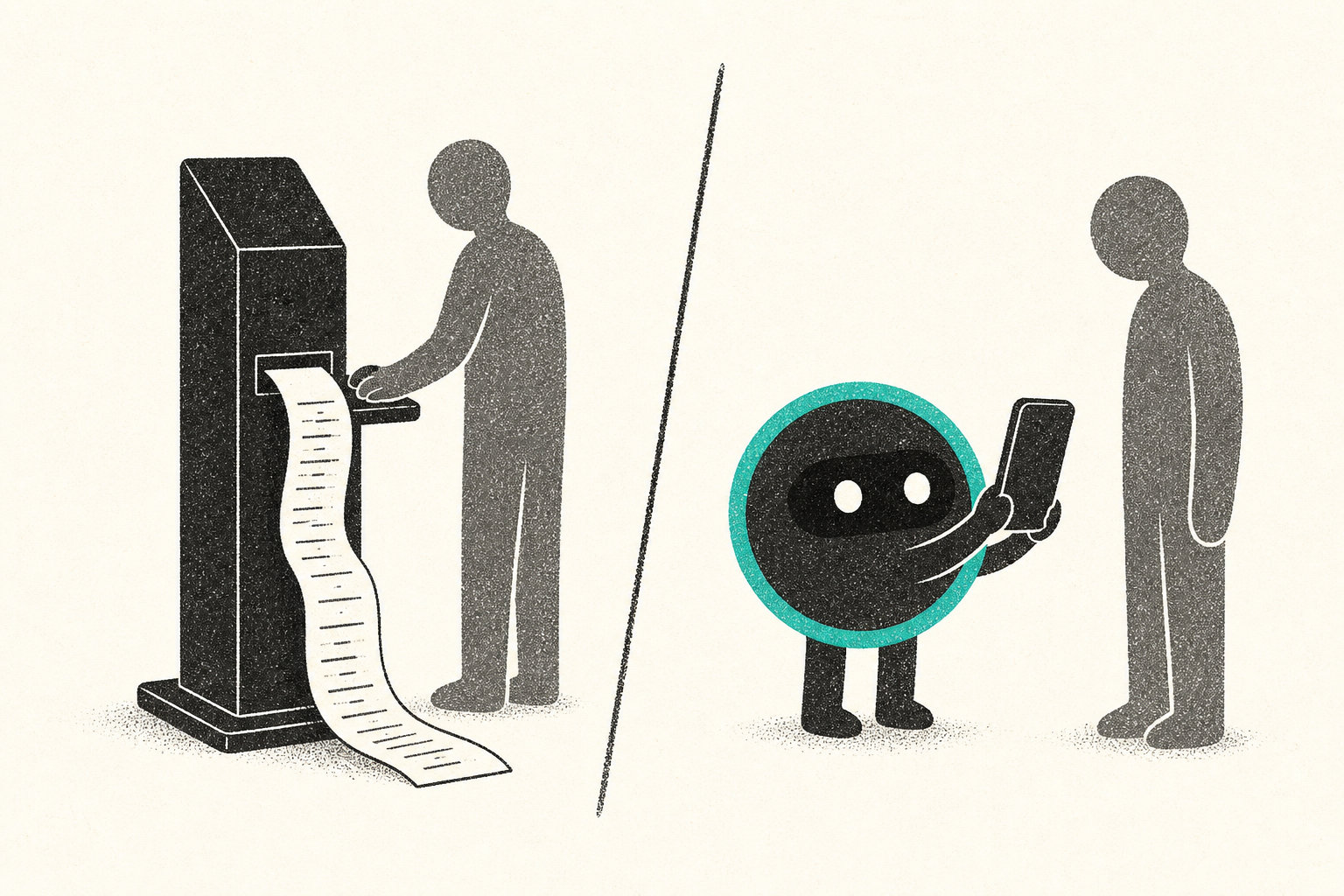
On Evolt, the walkthrough is a report and a sheet. If the scanner is offline, scans do not upload. On ShapeScale, photoreal 3D, girths, volumes, and heatmaps are on iPhone or iPad during the consult. Staff can export a PDF of one scan or a two-scan compare. The app is iOS only. Android is not available.
Does a still on this page mean the consult is iPad-only?
No. The app runs on iPhone or iPad.
Do staff have to tap anything to scan a return client?
No. First scan uses a QR code from the app. After that: rainbow lights, face and body recognition. No app. No buttons. Works across even hundreds of users.
Does the app help personalize a treatment plan?
Yes. AI guidance on goals is in the app. Saves consult time. Compare + heatmap + PDF are still the visual.
Does recognition work with a lot of clients?
Yes, after the first QR scan, across even hundreds of users.
Can both the provider and the client use the app?
Yes, if staff share or invite. Both sides see the scans on iOS. Android clients stay managed and get the PDF. Android app is not available.
Can Evolt show a treated-area change?
No. Same BIA class. ShapeScale is the local girth / volume / heatmap layer. Details sit on the InBody page.
Sources
- Evolt, How Accurate is the Evolt 360? (98-99% repeatability)
- Evolt, Why Are My Clients' Scan Results Wrong?
- Evolt scanning conditions
- Evolt sale terms
- Evolt missing scans (offline scanners do not upload)
- Ben Chalmers, Anytime Fitness (Evolt customer story)
- Jack / Vision PT, Evolt case study
- Evolt Active, US App Store (1.9 / 5, 94, 16 Aug 2026)
- Evolt Active, Google Play (2.7 / 5, 684, 16 Aug 2026)
- Potter 2022, InBody 770 vs iDXA (BIA-class, not Evolt)
- Lahav 2021, InBody 770 vs DXA (BIA-class, not Evolt)
- ShapeScale composition white paper, March 2026
- ShapeScale App Store (4.0 / 5, 43, iOS, 16 Aug 2026)